8 Differences Between Full Face Dermal Fillers and PRP Facials
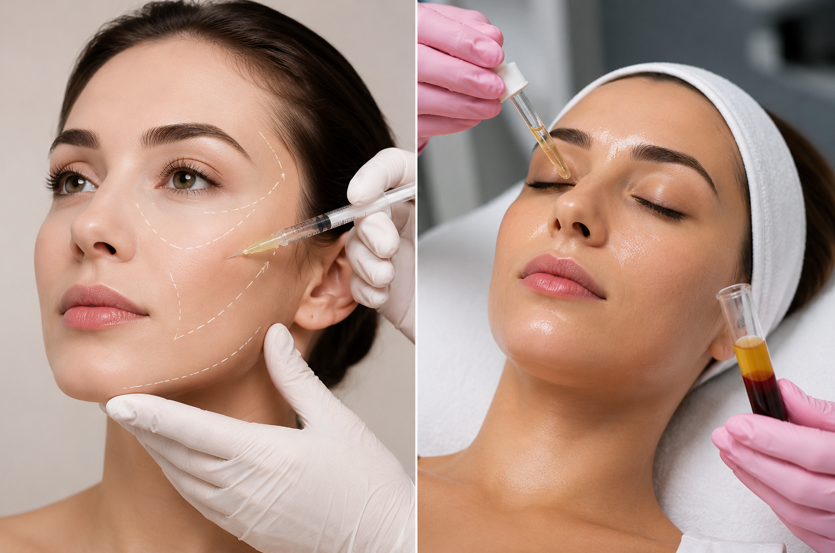
While both treatments offer comprehensive facial rejuvenation, full face dermal fillers use synthetic hyaluronic acid and PRP uses growth factors from your own blood. Choose Dermal Fillers if your primary concern is shadow formation and structural hollows caused by deep fat-pad migration. Choose PRP if your primary concern is structural laxity, fine lines, crepiness, or loss of superficial skin elasticity.
Key Takeaways
- Dermal fillers restore lost bone and fat volume to lift sagging features, while PRP focuses entirely on improving surface skin health, tone, and texture.
- Fillers provide immediate physical results that last up to two years, whereas PRP requires a series of treatments with results appearing gradually over several months.
- Fillers utilize lab-created, biocompatible gels that carry a tiny risk of reactivity, while PRP is 100% autologous (from your own body), virtually eliminating the risk of allergic reactions.
Modern aesthetic treatment has come up with various options, but choosing the right routine is often overwhelming. The two most popular treatment methods these days are PRP facial treatment and full-face dermal fillers.
Both of these procedures create a fresher and more youthful appearance, but they work in different ways. Dermal fillers can change your facial structure instantly, whereas PRP facial depends on your body’s natural healing power.
How Do PRP Facials & Full Face Dermal Fillers Differ?
Understanding the differences between the two can help you choose the treatment that will align with your skin condition, goals and lifestyle. Here is a quick comparison between the two treatment procedures.
| Feature | PRP Facial Treatment | Full Face Dermal Fillers |
| Main purpose | Improve skin quality and texture | Restore volume and contour |
| Primary treatment material | Patient’s own platelet-rich plasma | Hyaluronic acid fillers |
| Results timeline | Gradual | Immediate |
| Best for | Collagen stimulation and skin rejuvenation | Facial shaping and volume loss |
| Longevity | Several months with maintenance | 6-24 months |
| Downtime & social recovery | Mild redness for 1-3 days | Minimal |
| Risk of allergic reactions | No risk | Minimal risk |
| Financial investment pattern | Priced per session | Priced per syringe |
1. Treatment Areas
The two treatment processes target different depths of facial anatomy. PRP facial treatment is a superficial treatment that uses microneedling to create numerous tiny channels in the outer layer of the skin. The platelet-rich plasma drops into these micro-channels and repairs the upper dermis and epidermis.
Fillers are placed inside the facial tissues. Professionals inject them into fat pads or close to the bone to give your face an instant lift.
2. Treatment Material And Mechanism
The fundamental difference between the two is what the process is using to treat your skin. Full face dermal fillers use biocompatible materials, and the most common type is Hyaluronic Acid. When injected, it lifts the skin physically.
A PRP facial uses platelet-rich plasma derived from your own body. A professional draws a small sample of your blood and spins it in a centrifuge to separate the plasma. Then it is applied to your skin during a microneedling session.
3. Results Timeline
If you are looking for a quick transformation, then dermal fillers should be your option. The gel adds volume to your face the moment it is injected. You walk out of the clinic with filled-in cheeks, sharper cheekbones, and smoother lines. You might experience minor swelling, but you will notice immediate change.
But you will have to be patient with PRP. The growth factors stimulate elastin and collagen production over several weeks. Your skin will start glowing within a few days, but true anti-aging benefits will take two to three months to become visible.
4. Structural Volumization Vs. Surface Quality
Dermal fillers act like structural scaffolding. They restore lost bone and fat volume. They plump hollow cheeks, lift sagging jowls, and refine your jawline.
PRP facials do not fill structural hollows or build physical volume. Instead, they shrinks pores, improves skin texture, fades acne scars and evens out hyperpigmentation.
5. Longevity & Maintenance Cycles
PRP results last up to a year once you are done with the initial phase. However, a single session is not enough. Most medical aesthetics providers recommend a minimum of three sessions spaced one month apart. After that, you need one or two maintenance sessions in a year.
Fillers last a long time as your body takes time to metabolize the cross-linked gel. A full face filler can last from 6 to 24 months depending on the product used on your skin.
6. Downtime & Social Recovery
Neither of these options requires surgery, but they have different recovery timelines. With full face dermal fillers, you have to take care of minor swelling and localized bruising at the injection sites. You will be able to return to work in a day and hide the minor marks easily.
After a PRP facial, your face may remain red for the next 24 to 48 hours because of microneedling. You have to refrain from putting makeup on for at least 24 hours to prevent infection.
7. Risk Of Allergic Reactions
Dermal fillers use manufactured gels which can trigger an allergic reaction or a hypersensitivity flare-up. Whereas with PRP facial treatment there is no risk of an allergic reaction. The serum is harvested from your own blood and your immune system identifies it immediately, making it an ideal choice for people with sensitive skin.
8. Financial Investment
PRP facial treatments are charged per session, whereas dermal fillers are charged per syringe. Here is a breakdown of how they work.
| Feature | PRP Facial Treatment | Full Face Dermal Fillers |
| Pricing model | Per treatment session | Per syringe used |
| Initial cost pattern | Moderate per-session cost | Higher upfront investment |
| Total value lifecycle | Requires a three-session initial treatment series | Costs repeat every 12-18 months |
Can You Combine Full Face Dermal Fillers and PRP Facial Treatment?
Yes. In fact, combination treatments are becoming increasingly popular. Many aesthetic providers now use fillers and PRP together because they address different aspects of facial aging.
Fillers restore lost volume. PRP improves skin quality and collagen production. The result is often a more balanced and natural-looking outcome. This trend reflects the growing demand for subtle enhancements rather than dramatic changes.
See also: A Site Manager’s Guide to Dust Emission Regulations in Australia
Choose Your Best Option
Your best choice depends on what you are looking for, or what your face needs right now. or if you are experiencing loss of facial volume or contour. If you want to minimize acne scars, erase sun damage, and get a radiant complexion, then a PRP facial should be your choice.
If you are certain that you want these treatments, you should always choose a reliable and trustworthy clinic. Choose a clinic that puts patients first and supports you throughout the process.