
Liquid Silicone Injection Molding vs Compression Molding: Which Is Better?
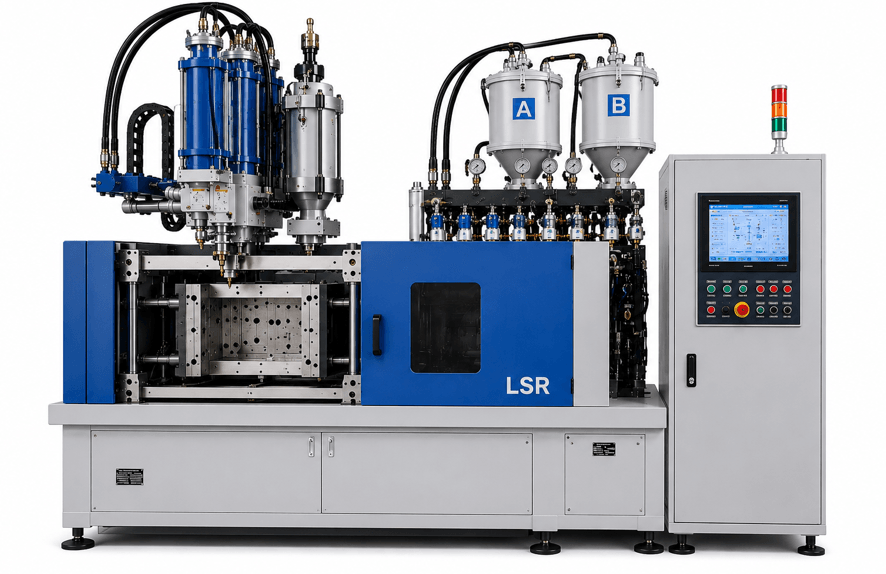
Choosing the right manufacturing process for silicone components is a vital decision that impacts product performance. Liquid silicone injection molding is primarily used to produce high-precision and flexible parts for different industries, while compression molding is used to develop components combining heat and high pressure.
Key Takeaways:
- Liquid silicone rubber is highly applicable for molding because of its high flexibility and retained physical properties in high heat.
- Liquid silicone injection molding is used for the precise molding of components.
- The production cycle time is longer in compression molding.
For component manufacturers in the USA, the debate often centers on two primary methods of making components: Liquid silicone injection molding (Liquid Silicone Rubber or LSR) and compression molding. While both processes lead to high-quality silicone parts, they operate on fundamentally different mechanical principles.
In this guide, we are doing a technical comparison to help you determine which process aligns with your production volume, precision requirements, and budgetary constraints.
What is Liquid Silicone Injection Molding?
Liquid silicone injection molding is a highly automated, rapid process designed for precision and high-volume manufacturing. It comprises a two-part liquid platinum-cured silicone that is mixed in a 1:1 ratio.
The Process
In this process, the cold liquid silicone is injected into a heated mold cavity. The heat triggers a chemical reaction that transforms the liquid into a solid and durable part. What makes liquid silicone rubber molding a good solution for making these components is its flexibility and elasticity at -70°F. It can also retain its properties up to 40 – 50°F.
What is Compression Molding?
Compression Molding is the traditional method of silicone manufacturing. It uses High Consistency Rubber (HCR), which has a putty-like texture. This component-making process uses heat and pressure to shape materials into desired forms.
Usage
HCR is used in a preformed shape and is placed into the bottom half of a heated mold. The mold is then closed, and a combination of heat and massive pressure (often 800-2000 psi) forces the material to fill the cavity. Once the material cures, the mold opens, and the part is manually or semi-automatically removed.
While it lacks the high-speed automation of LSR, it remains a powerhouse for large, bulky, or thick-walled components.
Technical Comparison: LSR vs. Compression Molding
We need to analyze the performance metrics that matter most to engineers and procurement specialists. Hence, here is the technical comparison between liquid silicone injection molding and compression molding.
| Metrics | Liquid Silicone Injection Molding | Compression Molding |
| Production Speed and Automation | Designed for faster manufacturing. The cycle times are significantly shorter because the liquid material reaches the cure temperature faster than solid HCR | Cycle times are often longer (it may take several to ten minutes to manufacture thicker parts). |
| Precision and Tolerances | It is the gold standard for parts requiring tight tolerances, such as medical-grade valves or intricate electronic seals. | Due to the manual nature of material placement and the way the mold closes, tolerances are wider. |
| Material Efficiency and Waste | The closed-loop injection system minimizes the material waste. It is a ‘flash-less’ process, meaning every gram of silicone becomes part of the final product. | Often produces more waste. To ensure the cavity is filled under pressure, ‘overflow’ becomes necessary. Thus, excess material is created and must be trimmed away. |
Table 1: The Technical Comparisons of liquid silicone injection molding and compression molding
Industry-Specific Applications
Here are some industries where these silicone component manufacturing processes are heavily used.
Medical and Healthcare
The medical industry heavily favors liquid silicone rubber molding. Because it is a closed system, the risk of contamination is virtually eliminated. It is used for Class II and III medical devices, catheters, and respiratory masks, where biocompatibility and precision are non-negotiable.
Automotive and Aerospace
For complex gaskets, connector seals, and spark plug boots, LSR molding is the preferred choice due to its ability to withstand extreme temperatures while maintaining exact dimensions. However, for large, heavy-duty vibration isolators or floor mats, compression molding is often more cost-effective.
Consumer Goods
Kitchenware, baby bottle nipples, and wearables benefit from LSR’s aesthetic clarity and soft-touch feel. Compression molding is frequently used for simpler items like silicone phone cases or bulky industrial stoppers.
Liquid Silicone Injection Molding Vs Compression Molding: When To Choose?
Both of these molding methods have their own advantages.
Liquid Silicone Injection Molding is used when:
- You require high-volume production.
- Your part has complex geometries or thin walls.
- You need tight tolerances and minimal flash.
- Labor reduction is a priority.
Compression molding can be opted when:
- You are producing a low to medium volume of parts.
- The part is large, thick, or geometrically simple.
- Upfront tooling budget is limited.
- The material required is a specific High Consistency Rubber (HCR).
See also: Converting Leads into Customers Using WhatsApp Page and Telegram Chinese
Final Verdict: Which is Better for Your Project?
Well, there is no final winner. Both these processes are heavily used under different industrial contexts and resources. Compression molding is better for large, simpler parts, while liquid silicone injection molding is used in complex, high-precision, and fast-curing components.
Choose the Correct Molding Process for Quality Production!
Looking to choose between liquid silicone injection molding and compression molding? By selecting the correct molding process today, you ensure a more durable, cost-effective, and high-performing product tomorrow.